Modular Prototype Molds
Replaceable-insert tooling for fast design changes and shorter iteration cycles.
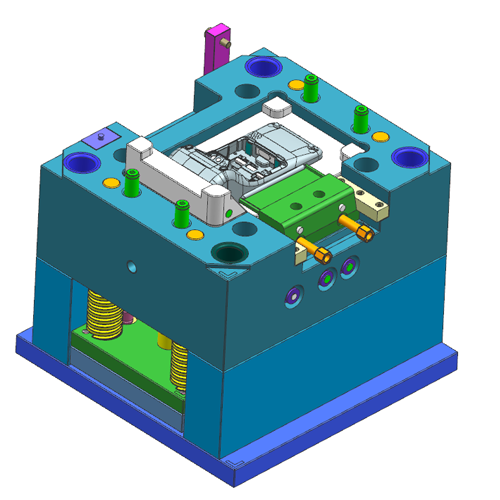
When your design is still evolving, the fastest path is often a modular insert strategy. We isolate high-risk features so changes don’t require rebuilding the full tool.
When Modular Prototype Tooling Makes Sense
- Part geometry is not fully frozen
- Critical clips/shutoffs/seal features may change
- You need multiple revision loops (Rev A → Rev B → Rev C)
- You want to protect the schedule by reducing the rework scope
What You Need to Send for a Fast Quote
- Material/resin + additives
- CTQ dimensions (interfaces, sealing, assembly)
- Expected number of iterations (best estimate)
- Target timeline for T0/T1
Design Options (How We Build Change-Friendly Tools)
- Modular inserts on shutoffs, clips, seal lands, and thin-wall sections
- Gate approach selected to support changes without a major rebuild
- Ejection layout designed to avoid damage to revision-sensitive features
- Practical cooling layout aligned with iteration needs
Common Failure Modes & How Modular Design Helps
Flash on Shutoffs / Insert Edges
Modular insert fit control improves shutoff stability and simplifies correction.
Part Sticking / Ejection Damage
Insert-level optimization allows quick correction to draft/ejection support.
Dimensional Drift on Interfaces
CTQ regions are isolated into controllable insert sets for targeted adjustment.
Parameters (Typical Options)
| | |
|---|
Single critical insert set | | Lowest complexity modular approach |
| Several revision-sensitive zones | Faster iteration across multiple features |
Bridge-ready modular tooling | Pilot runs + learning cycles | Extends usefulness beyond early sampling |
Start a Free 24h DFM Review
Not sure which one is right for you?
- Need to run 5,000+ parts before your mass production mold is ready? → Bridge Tooling